"I AM" Campaign

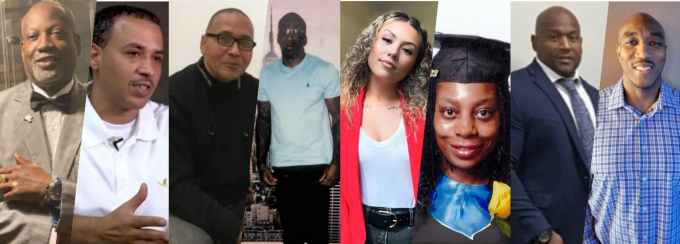
"I AM" Campaign Interviewees From Left to Right: Jerome Wright, David Sell, Anthony Dixon, Brandon Dannis, Chelsea Kuss, Missy Robinson, Walter Ball, and Thomas Gant.
The "I AM" Campaign is a Criminal Justice Advocacy Clinic project that aims to share the human stories behind parole reform. Student attorneys in the clinic interviewed and compiled the narratives of currently and formerly incarcerated individuals. The project launched with a panel discussion on April 18, 2025.
The “I AM” Campaign aims to share the real stories of currently and formerly incarcerated people embody the need for parole reform. It highlights the success of individuals released on parole who have returned to their communities as contributing members, leaders, and advocates. We associate these success stories with those of currently incarcerated people with similar backgrounds and accomplishments who would benefit greatly from parole reform. Our goal is to show the faces of incarcerated people who no longer pose a risk to society and have undertaken great efforts to improve their communities from within prison while they languish behind bars waiting for the day they can appear before the parole board.
Students in the Criminal Justice Advocacy Clinic at the University at Buffalo School of Law interviewed people from New York State, each of whom is serving or had served an indeterminate prison term. With their input, we present these stories as reminders of the real people behind bars who are often framed simply as “criminals.” However, many of these people have made great strides in improving themselves and their communities through education and advocacy work.
What follows are nine personal narratives from formerly and currently incarcerated individuals. These narratives shed light on the lives of individuals who have been impacted by the flaws of the current criminal legal system. In each of these stories, we see common threads: shared histories of trauma, struggle, and resilience. More importantly, we see people who have changed, grown, and become leaders on the inside and in their communities. But we also see a glaring difference in outcomes. Half of these stories end with individuals who are granted parole and return to their families, while the other half remain incarcerated. Nevertheless, those currently incarcerated continue to fight for themselves, for other incarcerated people, and for the people in their communities.


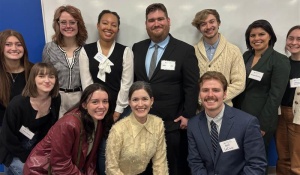
Student attorneys of the 2025 Criminal Justice Advocacy Clinic with clinic director, Alexandra Harrington, and staff attorney, Annabel Mannion.
As student attorneys in the Criminal Justice Advocacy Clinic, we represent people seeking parole release and appealing denials of parole. We also advocate for parole and resentencing reforms in New York State. Through this work, we engage with individuals whose lives have been shaped by hardship, trauma, and systemic neglect. Each conversation offers a raw and deeply human perspective, revealing how profoundly circumstances can influence the choices we make. The people we meet are not defined solely by their criminal records. Many were children born into environments of adversity—suffering long before their first offense. Their stories serve as poignant reminders that they were often prisoners of their circumstances long before they became prisoners of the state.
In addition, we also hear about the crushing reality of life inside New York’s prisons, including the re-traumatization that comes with repeated parole denials. Many of our clients face their fifth, sixth or ninth parole hearing, only to be met with the crushing disappointment of yet another denial even after doing everything they can to show how much they have grown since the start of their incarceration. However, even in the face of overwhelming adversity, there are stories of hope—stories of individuals who continue to hope for the day they can return to their families upon release and of individuals finally granted parole, returning to their families, contributing to their communities, and advocating for those still behind bars.
Our aim is to capture the humanity of incarcerated individuals and their transformation, ensuring their voices are heard with the dignity and depth they deserve. Our mission is to elevate their stories—not as mere statistics, but as real people striving for a second chance.

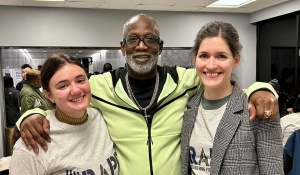
Jerome Wright with Alexandra Harrington, clinic director, and a CJAC Student Attorney
"'I Am'...two of the most powerful words in existence. For what you put after them, you become."
So, why an "I Am" Campaign you ask? Foremost, it's to highlight the two parole bills presently before the legislature (Fair & Timely Parole and Elder Parole) but here, it's expressed in the context and words of men and women who were formerly and those who are currently incarcerated.
The juxtaposition of the two realities is that beyond a statement of existence, "I Am" is used to tell someone about yourself and/or what you are doing. Who you are NOW, in this space and time; after having personally examined yourself honestly, allowing you to become what you now consciously choose.
This campaign is precisely about extolling the many and varied virtues of those who have consciously demonstrated their maturation and change, thereby refusing to be defined by one bad act, or the worst days of their life. Inside or out, EVERYONE is more than the sum of a few parts; good or bad parts. More importantly, the similarities between those incarcerated or not, as shown by their stories are not the quantum leap one might imagine, but are similarly demonstrative examples of the power and processes one undertakes towards rehabilitation, redemption and ultimately release back to society.
I Am as you are still a work in progress, under construction but no where near who WE used to be!


Speakers at April 18, 2025 Panel Discussion
- Walter Ball: Walter Ball spent over 23 years incarcerated before finally being granted parole. While incarcerated, Walter co-founded a community-based youth mentoring program called “Change Comes From Within” and has been a strong advocate against gun violence in the community.
- Thomas Gant: Thomas Gant spent over 23 years incarcerated before his parole release. He is now a Community Organizer for Center for Community Alternative and continues to advocate for those directly impacted by the criminal legal system.
- Donna Robinson: Donna Robinson is a community organizer for Releasing Aging People in Prison and is the mother of a currently incarcerated woman named Al-Shariyfa “Missy” Robinson. Missy has been incarcerated for seven years and will not be eligible for parole until 2030, when she is 55 years old.
- George Schreier: George Schreier is the father of a formerly incarcerated individual and a retired Corrections Sergeant. His unwavering support through 12 years of parole denials helped his son through incarceration until he could finally welcome him home. Clinic students represented George's son at his parole hearings and appeals.
Presented by Criminal Justice Advocacy Clinic.
For more information, contact law-cjac@buffalo.edu.